
Comparisons
AI Chatbot vs Live Chat: Which Should You Choose?
By ZoeyAI · · 8 min read
AI chatbot vs live chat is one of the first decisions a business faces when it wants to talk to website visitors in real time. Live chat puts a person on the other end of the conversation. An AI chatbot answers automatically, using what it has been taught about your business. Each has real strengths and real limits, and for many businesses the best answer is a combination of the two.
This guide compares them honestly, so you can decide based on how your business actually runs rather than on a sales pitch.
What is live chat?
Live chat is a messaging window on your website that connects visitors to a member of your team. Someone has to be available to reply, so its usefulness depends on who is watching the inbox and when. At its best, it is personal, flexible and persuasive. At its worst, it is a chat bubble that says "we'll reply shortly" while nobody is around.
Live chat suits situations where the conversations are sensitive, complex or high-value, and where you have people who can respond quickly during the hours your visitors are online.
What is an AI chatbot?
An AI chatbot is software that reads a visitor's question and writes a reply in natural language, drawing on the information you have supplied, such as your website content, FAQs and instructions. It can respond instantly at any hour, handle many conversations at the same time and collect contact details so your team can follow up.
It is different from the older rule-based chatbots that offered a menu of buttons and a fixed script. An AI chatbot can cope with questions phrased in unexpected ways. The trade-off is that, because it generates language, it needs good source information and sensible guardrails to stay accurate.
AI chatbot vs live chat: how they compare
| AI chatbot | Live chat | |
|---|---|---|
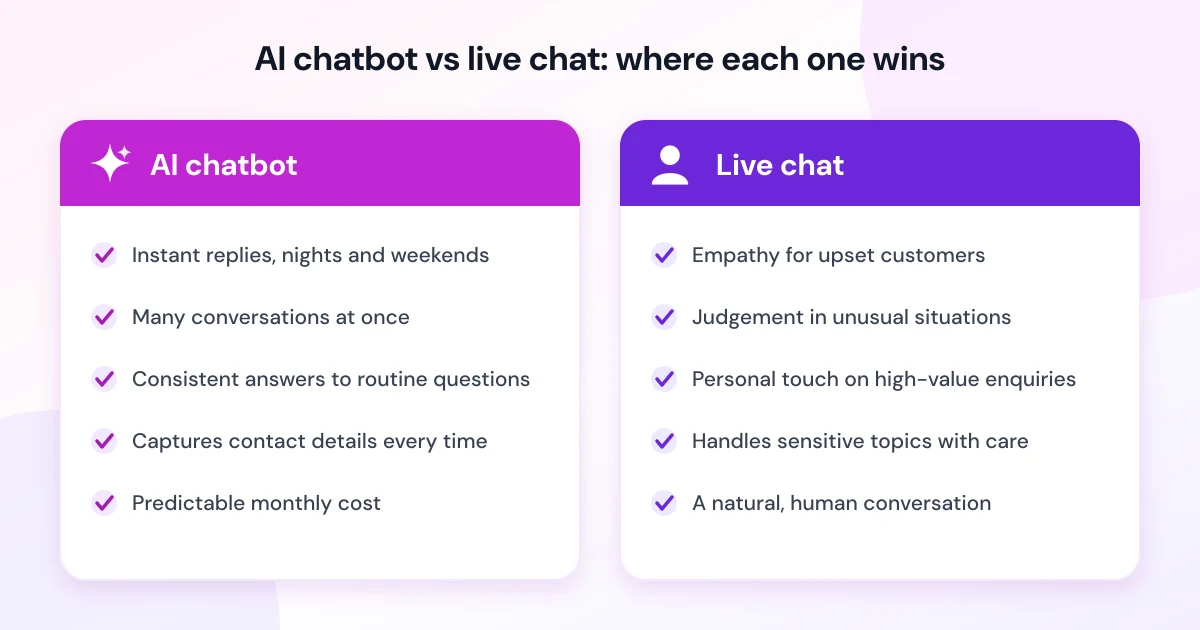
| Availability | Any hour, including nights and weekends | Only when someone is staffing it |
| Response speed | Immediate | Depends on your team's workload |
| Handling many visitors at once | Yes | Limited by the number of people available |
| Empathy and judgement | Limited, improving but not human | Strong |
| Accuracy | Depends on training and review | Depends on the individual's knowledge |
| Cost structure | Subscription, usually predictable | Staff time, which grows with coverage hours |
| Best for | Routine questions, enquiries, after-hours coverage | Complex, sensitive or high-value conversations |
None of these cells is absolute. A well-trained AI chatbot can be more consistent than a tired person, and an experienced human can solve problems no script anticipated. The table describes tendencies, not guarantees.
Cost: staff hours versus a subscription
The cost difference comes down to how each option scales. Live chat costs whatever your staff time costs, and covering evenings and weekends means paying for evenings and weekends. If you are a small team, you may simply not be able to staff chat during the hours when many visitors browse.
An AI chatbot is typically a monthly subscription. With ZoeyAI, for example, the Basic plan is $29 a month (incl. GST) for 100 AI conversations and the Pro plan is $79 a month (incl. GST) for 250, with prices in Australian dollars. You can compare the plans in the pricing section. Even so, the cheapest option is not automatically the best. A chatbot that gives wrong answers can cost you customers, which is why the quality of training and the handover rules matter as much as the subscription fee.
Coverage: when do your customers actually ask?
Before choosing, look at when enquiries reach you. Check your email, phone log and contact form timestamps for a few weeks:
- If most enquiries arrive during business hours and you can answer within a minute or two, live chat can work well.
- If enquiries arrive in the evenings, on weekends, or while you are on a job, with a patient or in a meeting, an AI chatbot fills a gap that live chat cannot, unless you can afford extra staff.
A visitor who gets no reply usually leaves and tries the next business in the search results. Speed matters most at the moment of interest.
Quality and accuracy: the honest risks
Both options can go wrong.
AI chatbot risks. Generative AI can produce confident answers that are wrong. The Office of the Australian Information Commissioner notes that AI systems are known to produce inaccurate results, and recommends careful testing of customer-facing chatbots before you deploy them. You can reduce the risk by limiting what the chatbot is allowed to talk about, keeping its information up to date and making handover to a person easy. Read the OAIC's guidance on privacy and commercially available AI products before launch.
Live chat risks. Human agents can be slow, inconsistent, unavailable or simply wrong. Training and scripts help, but quality varies from person to person and from hour to hour.
Privacy and transparency obligations apply to both
Whichever you choose, a chat window collects personal information such as names, phone numbers and the content of messages. The Australian Privacy Principles set out how organisations covered by the Privacy Act must collect, use and disclose that information. For AI specifically, the OAIC advises that public-facing chatbots should be clearly identified as AI, and that your privacy policy and collection notices should explain how AI is used. Not every small business is covered by the Privacy Act, so check whether it applies to you. This article is general information, not legal advice.
The Australian Government's Voluntary AI Safety Standard is a further resource. It sets out ten voluntary guardrails to help organisations deploy AI safely and reliably, and it is useful as a checklist when you review a vendor.
When live chat is the better choice
Live chat tends to win when:
- Conversations are emotionally sensitive, such as complaints, disputes or health concerns
- Each enquiry is high-value and benefits from a personal, consultative approach
- Volume is low enough that your team can reply promptly
- You already have people online during the hours your visitors browse
When an AI chatbot is the better choice
An AI chatbot tends to win when:
- Visitors repeatedly ask the same questions about hours, services, areas and process
- You receive enquiries outside business hours or while your team is busy
- You are a small team and cannot staff a chat window all day
- You want every enquiry captured with contact details, even when no one is free
The hybrid approach: AI first, humans for what matters
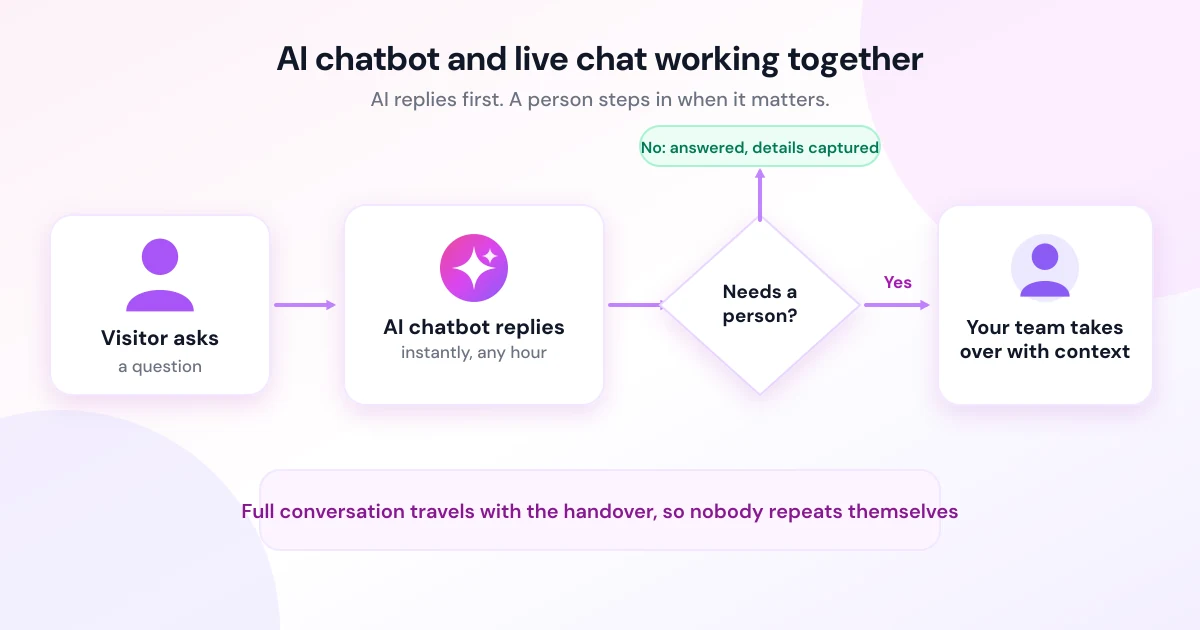
For many small businesses, the strongest setup is not a choice at all. The AI chatbot greets visitors, answers routine questions and captures details at any hour. When a conversation turns sensitive, complicated or valuable, a person steps in. The key is that the handover is easy for you and seamless for the visitor.
This is how ZoeyAI is designed to work. The AI replies using the training you have provided. When it cannot answer something, it collects the visitor's contact information and flags the conversation for review. From your dashboard you can jump into any active conversation yourself using human takeover, which is available on the Basic plan and above. The free Starter plan offers human-only live chat with no AI, so you can begin with the staffed model and add AI when you are ready.
How to decide in five questions
- When do visitors contact you, and can you reply then? If not, you need automation.
- How repetitive are the questions? If you are answering the same ten questions every week, an AI chatbot will take that load.
- How sensitive are the conversations? The more sensitive, the more you want a human close by.
- What can you maintain? A chatbot needs periodic review. Live chat needs rostering. Pick the one you will keep up.
- Can you try before you commit? A free trial lets you see real conversations rather than guessing.
If you decide an AI chatbot suits you, our guide on how to add an AI chatbot to your website covers the setup step by step.
Frequently asked questions
Is an AI chatbot better than live chat?
Neither is better in every situation. An AI chatbot is better for instant, round-the-clock answers to routine questions. Live chat is better for sensitive or complex conversations. Many businesses use both, with the AI replying first and a person taking over when needed.
Can an AI chatbot replace live chat completely?
For some businesses with simple, repetitive enquiries, it can handle most conversations. But it is wise to keep a path to a real person for anything the chatbot cannot resolve, and to review conversations regularly.
What happens when the AI chatbot cannot answer?
That depends on the platform. With ZoeyAI, the chatbot collects the visitor's contact details and flags the conversation for human review, and you can also step into an active conversation from your dashboard.
Is live chat cheaper than an AI chatbot?
Live chat can be inexpensive if you already have people available during the hours visitors browse. It becomes costly when you need extended coverage. An AI chatbot is usually a predictable monthly subscription, though plans typically include a limit on conversations.
Do I have to tell customers they are talking to an AI?
The OAIC advises that public-facing chatbots should be clearly identified as AI. Being upfront is good practice and builds trust. Check your obligations under the Privacy Act and any rules specific to your industry.
Can I start with live chat and add AI later?
Yes. ZoeyAI's free Starter plan provides human-only live chat, and you can move to a paid plan to turn on AI replies whenever you are ready.
Keep reading
"AI Chatbot Privacy Australia: What the Privacy Act and APPs Mean for Your Business"
AI chatbot privacy Australia guide covering the Privacy Act, the Australian Privacy Principles, commercially available AI products, data security, spam consent and practical steps for website chatbots.
"Intercom Alternative for Small Business: How to Choose Without Overpaying"
Looking for an Intercom alternative for small business? Compare what Intercom is built for with what SMBs usually need from an AI chatbot, lead capture and human handover — with Australian pricing and privacy notes.