
Guides
"AI Chatbot Privacy Australia: What the Privacy Act and APPs Mean for Your Business"
By ZoeyAI · · 8 min read
AI chatbot privacy Australia is not a niche legal topic for big tech. If your website chatbot collects a name, email, phone number or anything that identifies a visitor, you are handling personal information. That means you need a clear purpose for collecting it, a privacy policy visitors can find, and practical controls so transcripts and leads are not shared more widely than they need to be.
This guide is for Australian small and medium businesses using a website AI chatbot. It covers the Privacy Act and Australian Privacy Principles (APPs), OAIC guidance on commercially available AI products, and practical steps that keep a chatbot useful without creating avoidable privacy risk. It is general information, not legal advice.
Why chatbots raise privacy questions
A contact form usually collects a short set of fields. A chatbot conversation can collect those fields plus a free-text history of what the visitor asked, what the bot replied, and what a human said after takeover. That transcript often sits in a dashboard, an email notification or a CRM.
Typical personal information in a chatbot includes:
- Name, email address and phone number
- The substance of the enquiry (which can reveal health, financial or other sensitive details)
Under Australian privacy law, personal information is information or an opinion about an identified individual, or an individual who is reasonably identifiable. The Office of the Australian Information Commissioner (OAIC) publishes an overview of the Privacy Act and guidance for organisations on privacy for organisations. Whether the Act applies to your business can depend on factors such as turnover and the type of information you handle. Do not assume a chatbot is "just a widget" and therefore outside the rules.
The Australian Privacy Principles that matter most for chatbots
If your business is covered by the Privacy Act, the Australian Privacy Principles set out how personal information should be managed. The OAIC's Australian Privacy Principles page is the starting point, and the APP guidelines go into more detail.
For a website chatbot, the practical themes are:
- Open and transparent management (APP 1). Have a clear, up-to-date privacy policy that covers chatbot collection, and make it easy to find from the chat or the site footer.
- Anonymity and pseudonymity (APP 2). Where practicable, let people ask general questions without giving identifying details. Do not force a name and phone number before the chatbot answers a public FAQ.
- Collection (APP 3 and APP 5). Collect only what you need for the enquiry, and tell people why you are asking at the point of collection.
- Use and disclosure (APP 6). Use lead details for the purpose you stated (for example, to reply to their quote request), not for unrelated marketing unless you have a lawful basis and the right consent.
- Security (APP 11). Take reasonable steps to protect transcripts and contact details from misuse, interference, loss and unauthorised access.
- Access and correction (APP 12 and APP 13). Be ready to handle requests from individuals about personal information you hold.
You do not need to quote APP numbers in the chat. You do need processes that match them.
What OAIC says about commercially available AI products
Many Australian businesses use a third-party chatbot platform rather than building one from scratch. The OAIC has published guidance on privacy and the use of commercially available AI products. The guidance is aimed at organisations that deploy AI tools built by someone else.
Points that map cleanly onto a website chatbot:
- You remain responsible for how personal information is handled when you deploy the product in your business, even if a vendor hosts the software.
- Understand what the product does with inputs. Ask where conversations are stored, whether they are used to train models, who can access them and how long they are retained.
- Minimise what you send. Do not design the chatbot to invite credit card numbers, passwords, identity documents or health details into free text if you do not need them.
- Be transparent with customers that they are interacting with an AI system where that is relevant to the experience.
The Australian Government's Voluntary AI Safety Standard and its 10 guardrails are voluntary and do not create new legal duties on their own, but they reinforce the same ideas: human oversight, transparency with end users and careful handling of data. Being upfront that the visitor is talking to an AI (and that a person is available) is also good customer experience practice.
Practical privacy steps before you go live
Use this as a launch checklist, not a substitute for advice tailored to your business.
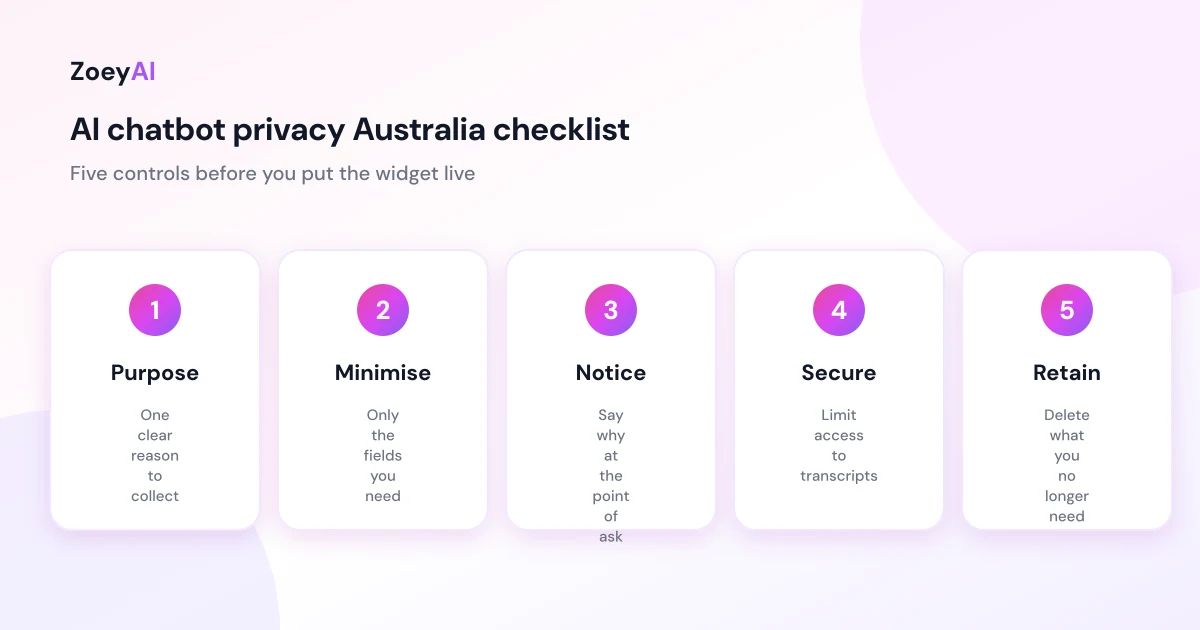
1. Decide the chatbot's job and the minimum data you need
Write one sentence: "This chatbot answers questions from our website content and captures contact details so we can follow up on quotes / bookings / support." Then list the fields you will collect. For most lead capture flows, name plus email or phone is enough. Add company name only if you sell to businesses. Avoid free-text prompts that ask for medical history, tax file numbers or payment details.
2. Update your privacy policy and point to it from the chat
Your privacy policy should say that you collect personal information through the website chatbot, why you collect it, how it is used, who it is shared with (for example, your chatbot provider) and how long you keep it. Link the policy from the site footer and, where the product allows, from the chat itself when contact details are requested. The OAIC's APP material on open and transparent management is a useful benchmark; see Chapter 1 of the APP guidelines.
3. Tell visitors why you are asking for details
When the chatbot requests a name and email, say something like: "So our team can reply to your enquiry." Do not bury that explanation. If you later want to send marketing emails, that is a separate consent question under the Spam Act — see ACMA's guidance on how to avoid sending spam.
4. Limit who can read transcripts
Give dashboard access only to people who need to reply to enquiries. Turn off shared logins. If you use human takeover, train staff to treat the full transcript as confidential customer information, the same way they would treat an email inbox.
5. Set retention and deletion habits
Decide how long you keep closed conversations and unused leads. Delete or archive what you no longer need. If a vendor offers retention controls, configure them deliberately rather than leaving defaults unreviewed.
6. Plan for a data breach
If personal information is accessed or disclosed without authorisation, organisations covered by the Notifiable Data Breaches scheme may need to assess and notify. The OAIC explains the scheme on its Notifiable Data Breaches page. Know who in your business would run that assessment if a chatbot account were compromised.
7. Secure the account and the site around the widget
Use strong unique passwords and multi-factor authentication on your chatbot admin account. Keep your website CMS and plugins updated. Weak account security is a common way personal information is exposed. The OAIC publishes a guide to securing personal information, and ASD's Essential Eight is a useful security baseline.
What the chatbot should never do
Train (and test) your chatbot so it does not:
- Ask for payment card numbers, one-time passwords or identity document scans in chat
- Invent privacy or legal advice
- Promise that data "is never stored" or "is fully anonymous" unless that is actually true for your setup
- Email marketing messages without the consent rules that apply to your channel
- Hand a transcript to a third party (marketing agency, freelancer, another vendor) without a proper arrangement and a purpose that matches what you told the customer
If you are still building the knowledge base, our guide on how to train an AI chatbot on your website content covers limiting what the bot is allowed to say. For the moment a person needs to take over, see AI chatbot human handover best practices.
Privacy-friendly lead capture that still converts
Privacy and lead generation are not opposites. A clear, short form inside the chat often converts better than a long interrogation. Ask for contact details after the visitor has shown intent (for example, after asking for a quote or booking), explain why you need them, and offer a human path. Our AI chatbot for lead generation guide walks through what to ask and when to hand over.
After hours, be honest that the team is offline, save the conversation and collect only what you need for a next-day reply. That pattern is covered in AI chatbot for after-hours enquiries.
What does it cost?
ZoeyAI has a free Starter plan for live chat without AI. AI plans start at $29 a month incl. GST on Basic (100 conversations a month, knowledge base, website scanner, business hours and human takeover) and $79 a month incl. GST on Pro (250 conversations a month, up to 5 team seats, webhooks, CSV export and branding removal). Annual billing on Basic and Pro works out cheaper per month, and Enterprise pricing is available on request. Every new account starts with a 7-day free trial. See the full comparison in our pricing section.
Frequently asked questions
Does AI chatbot privacy Australia law mean every small business must comply with the APPs?
Not automatically. Coverage under the Privacy Act depends on your situation, including factors such as annual turnover and the kinds of information you handle. Many small businesses still choose to follow APP-style practices because customers expect them and because growth can change whether the Act applies. Check the OAIC materials on the Privacy Act or get advice for your business.
Can my chatbot store conversation transcripts?
Yes, businesses commonly store transcripts so staff can follow up and improve answers. If you store them, treat them as personal information: limit access, set a retention period, cover them in your privacy policy and make sure your vendor arrangement matches what you tell customers.
Should the chatbot say it is an AI?
Being upfront is good practice and aligns with voluntary Australian AI guidance on informing end users. It also helps visitors phrase questions appropriately and ask for a person when they need one. Industry-specific rules can differ, so check anything that applies to you.
Is collecting an email for a quote the same as marketing consent?
No. Collecting an email so you can reply to a quote request is different from adding that address to a promotional mailing list. Marketing messages have their own consent and identification rules under the Spam Act. See ACMA's spam guidance before you automate follow-up campaigns.
What should I ask a chatbot vendor before I buy?
Ask where data is hosted, whether conversation content is used to train models, who can access your workspace, how long data is retained, how you export or delete it, and what happens to data if you cancel. Compare those answers to your privacy policy and your customers' expectations.
Keep reading
"Intercom Alternative for Small Business: How to Choose Without Overpaying"
Looking for an Intercom alternative for small business? Compare what Intercom is built for with what SMBs usually need from an AI chatbot, lead capture and human handover — with Australian pricing and privacy notes.
"Tidio Alternative Australia: What to Look For in an AI Chatbot for Local Businesses"
Searching for a Tidio alternative Australia businesses can trust? Compare website AI chat, lead capture, human handover, AUD pricing incl. GST and Australian privacy expectations before you switch.