
Industries
"AI Chatbot for Car Dealerships: Capture More Vehicle Enquiries"
By ZoeyAI · · 7 min read
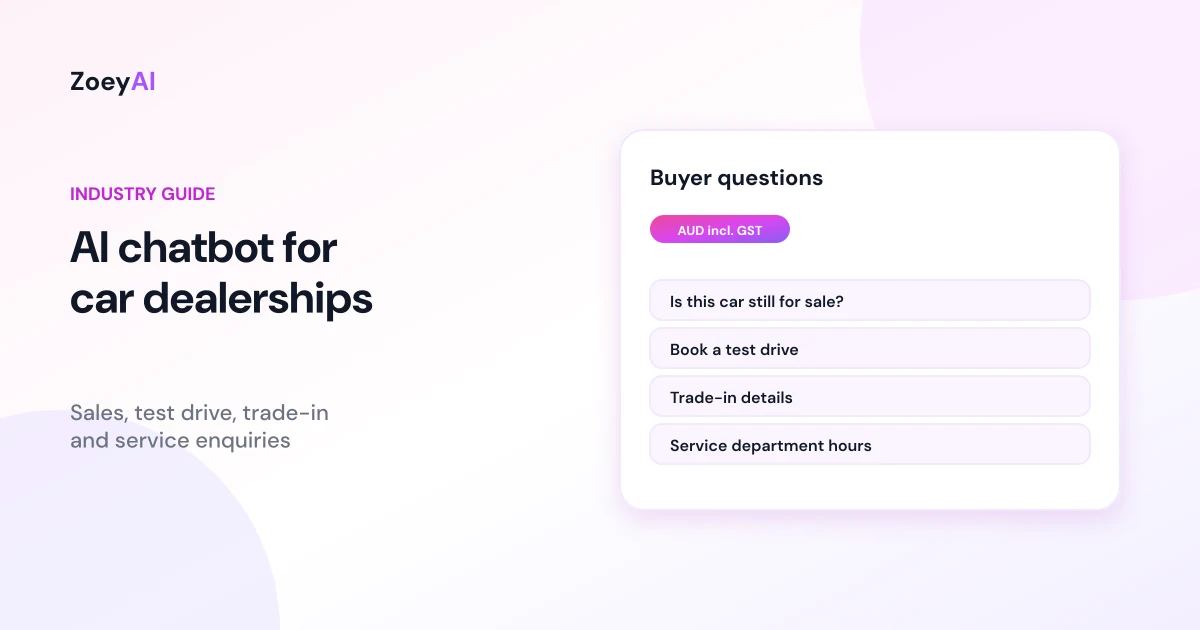
An AI chatbot for car dealerships answers the questions buyers ask while they browse your website: is this car still available, can I book a test drive on Saturday, do you take trade-ins, what are your service department hours, where are you located? Many of those questions arrive in the evening or on weekends, when people have time to research a car and your sales team has gone home or is busy on the yard. If nobody replies, the buyer often moves on to the next listing.
A chatbot can reply straight away using information you have approved, capture the buyer's details and the vehicle they are interested in, and pass the enquiry to the right person. This guide covers what a dealership chatbot should do, what it should never promise, how to stay on the right side of consumer law and how to tell whether it is helping.
What does an AI chatbot for car dealerships actually do?
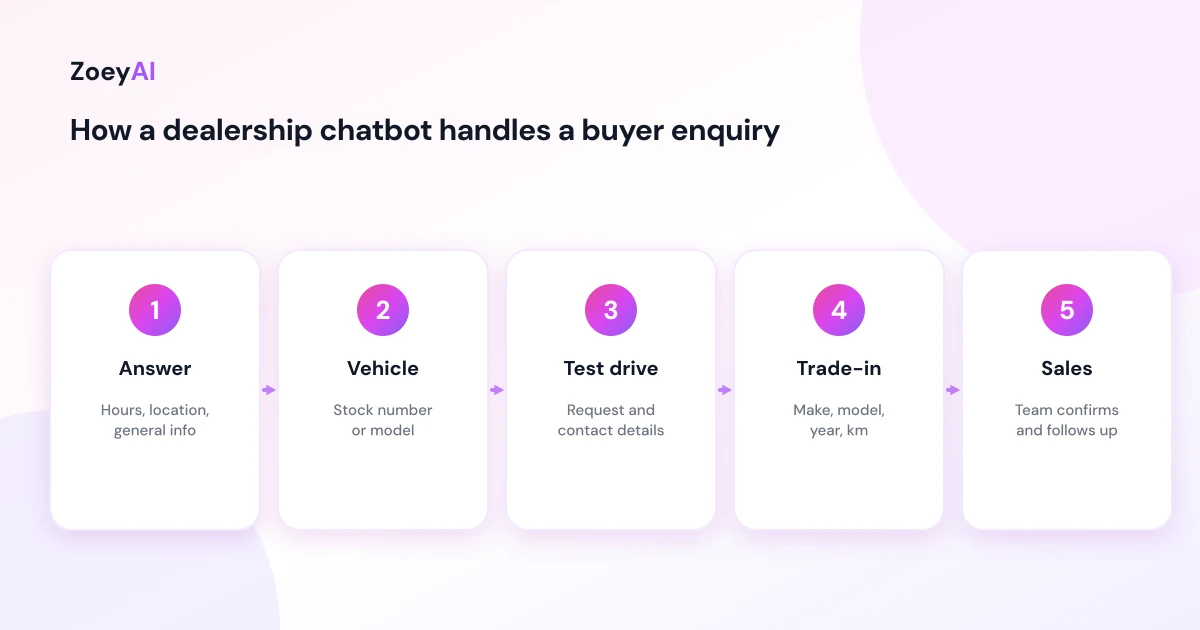
A well-set-up dealership chatbot handles four types of enquiry:
- Sales enquiries. Questions about a specific vehicle, the type of car someone is looking for, and whether you have something similar in stock. The chatbot captures name, phone, email and the stock number or model so a salesperson can follow up.
- Test drive requests. Preferred day and time, the vehicle, and contact details. Your team confirms the booking; the chatbot does not.
- Trade-in enquiries. The make, model, year and approximate kilometres of the buyer's current car, so your appraiser has a starting point. The chatbot should never give a trade-in value.
- Service and parts questions. Service department hours, how to book a service, location and what to bring. Service bookings can be linked to your booking system or captured for a call-back.
What it should not do is confirm a vehicle is available unless it can see live stock, quote a drive-away price you have not published, give a trade-in valuation, approve finance or make promises about a car's condition or history. Those belong to your sales, finance and service teams.
Accuracy matters: avoid misleading claims
Car buying is a high-value decision, and what your website says about a vehicle matters. Business Queensland's guide to advertising your business explains that under the Australian Consumer Law your advertising must be factual, discounts must be genuine and the overall impression must not be misleading, and that the ACL covers misleading or deceptive conduct and false or misleading representations. A chatbot reply to a customer is part of how you represent your vehicles and prices, so treat it with the same care as a listing or an ad.
In practice:
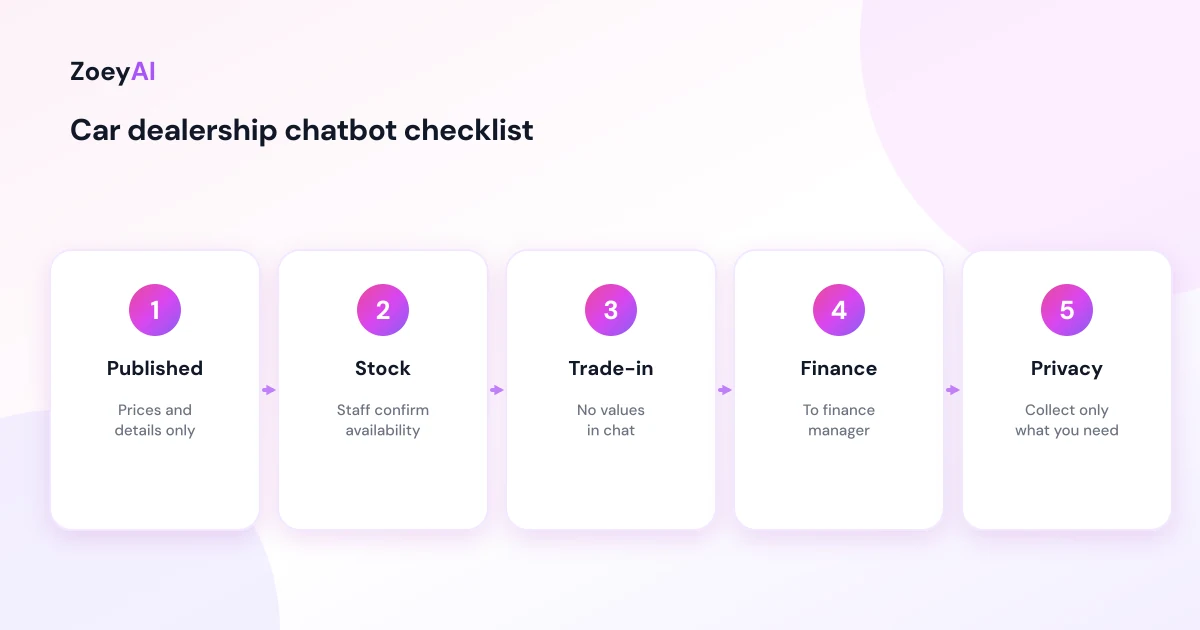
- Repeat only published details. Price, kilometres, features and warranty information should come from your listing, word for word.
- Never guess availability. If the chatbot cannot see live stock, it should say "Let me get the sales team to confirm this car is still available" and capture contact details.
- No condition or history promises. Questions like "Has it been in an accident?" or "Is the timing belt done?" need a person with the vehicle's records.
- No finance approvals or repayments. The chatbot can say you offer finance options if you do, and collect details for the finance manager. It should not estimate repayments or approval chances.
- Use "from" and "plus on-road costs" exactly as your listings do. Do not let the chatbot simplify pricing into something you did not publish.
Dealers also have licensing and conduct obligations that vary by state. For example, Consumer Affairs Victoria has a section on motor car traders covering licensing and running your business. Check the rules in each state you trade in, and keep the chatbot's answers inside what your compliance team is comfortable with.
The questions a dealership chatbot handles best
Typical questions a chatbot can answer from your own content:
- "What are your opening hours on Sunday?"
- "Do you take trade-ins?"
- "Can I book a test drive?"
- "Do you have any SUVs under a certain price?"
- "Do you offer finance?"
- "How do I book a service?"
- "Where is the service entrance?"
- "Is the car on your website still for sale?" (answered with a hand-over unless you have live stock data)
The most valuable conversations are usually sales and trade-in enquiries outside showroom hours. Our guide to AI chatbots for after-hours enquiries covers what to say when your team is offline, and AI chatbots for lead generation explains how to capture the details a salesperson needs without turning the chat into a long form.
What to train a dealership chatbot on
Keep the sources simple and current:
- Dealership details. Locations, showroom and service hours, public holiday trading, parking and contact numbers.
- How you sell. Test drive process, what to bring, deposits if you take them, and how trade-ins are assessed.
- Service department information. How to book, what to expect, loan cars or shuttle services if you offer them.
- Finance and warranty basics. Only general information you publish, such as "we offer finance options; our finance manager can discuss them with you".
- A short "never do" list. No trade-in values, no availability confirmation without live stock, no repayment estimates, no condition promises, no invented specials.
If your stock changes daily, decide whether the chatbot should talk about specific vehicles at all. Many dealerships do better keeping the chatbot to general questions and capturing the stock number for a person to confirm.
Be open that buyers are talking to AI
Buyers should know when they are chatting with an AI assistant. The business.gov.au guide to artificial intelligence for business notes that customers want to know when they are talking to an AI rather than a human for customer support, and that your business is responsible for everything your AI tools do. A simple greeting works: "Hi, I'm the dealership's AI assistant. I can answer general questions or pass you to our sales or service team."
Buyer details, privacy and marketing
Dealership enquiries often include names, phone numbers, emails and details of the buyer's current car. Collect only what you need for the next step and do not ask for licence numbers, dates of birth or financial details in chat. The Privacy Act 1988 and the Australian Privacy Principles set the rules for businesses covered by the Act, and your privacy policy should explain how chat enquiries are used.
Following up an enquiry is not the same as marketing. The Spam Act 2003 generally requires consent before you send commercial emails or texts, and each message needs an unsubscribe option. If you want to add buyers to a newsletter or new-stock alerts, ask separately.
Human handover: get leads to the right person
Route conversations by type:
- Sales enquiries to the sales manager or a lead rotation, with the vehicle and contact details attached.
- Trade-in details to your appraiser.
- Finance questions to the finance manager.
- Service bookings and questions to the service desk.
- Complaints or urgent problems, such as a breakdown after purchase, to a person by phone straight away.
ZoeyAI lets a team member take over a live conversation from the dashboard on Basic and Pro plans, and Pro adds webhooks so captured leads can be sent to tools like Zapier, Make or a CRM. Our human handover best practices explain how to make the switch from AI to person smooth.
How to tell if it is working
Look at practical results rather than chat counts:
- Sales and test drive enquiries captured, especially after hours
- How quickly the team follows up chat leads
- How many chat leads become appointments or sales
- Questions the chatbot could not answer, so you can add them
- Accuracy, by reading a sample of conversations each week
What it costs
ZoeyAI pricing is in AUD and includes GST. There is a free Starter plan for live chat without AI. AI plans start at $29 a month incl. GST on Basic (100 conversations a month, knowledge base, website scanner, business hours and human takeover) and $79 a month incl. GST on Pro (250 conversations a month, up to 5 team seats, webhooks, CSV export and branding removal). Enterprise pricing is available on request, and every new account starts with a 7-day free trial. See the pricing section for current details.
Frequently asked questions
Can an AI chatbot for car dealerships tell buyers if a car is available?
Only if it can see live stock information. Otherwise it should capture the stock number and the buyer's details and have the sales team confirm availability.
Should a dealership chatbot give trade-in values?
No. It can collect the make, model, year and kilometres of the buyer's car so your appraiser can follow up, but valuations need a person who can inspect the vehicle.
Can the chatbot book test drives?
It can capture a test drive request with the vehicle, preferred time and contact details, or link to your booking system. Your team should confirm the booking.
Can it answer finance questions?
It can say whether you offer finance and pass the buyer to your finance manager. It should not estimate repayments or say whether someone will be approved.
Does it work for the service department too?
Yes. Service hours, how to book, location and what to bring are common questions a chatbot can answer, with bookings linked to your system or captured for a call-back.
Will a chatbot replace our sales team?
No. It answers routine questions and captures enquiries when your team is busy or offline, so salespeople can spend their time on buyers who are ready to talk.
Keep reading
"AI Chatbot for Event Venues: Answer Capacity and Package Questions and Capture Enquiries"
How an AI chatbot for event venues answers questions about spaces, capacity, published packages and policies, captures wedding, corporate and party enquiries with the right details, treats dates as requests rather than bookings and hands every lead to your events team.
"AI Chatbot for Funeral Homes: Calm Answers and a Fast Path to Your Staff"
How an AI chatbot for funeral homes answers practical questions about services, published prices and what to do first, uses a calm and respectful tone, never pressures families, protects privacy and connects people with your staff quickly, including after hours.