
Industries
"AI Chatbot for Hotels and Accommodation: Answer Guests Before They Book"
By ZoeyAI · · 7 min read
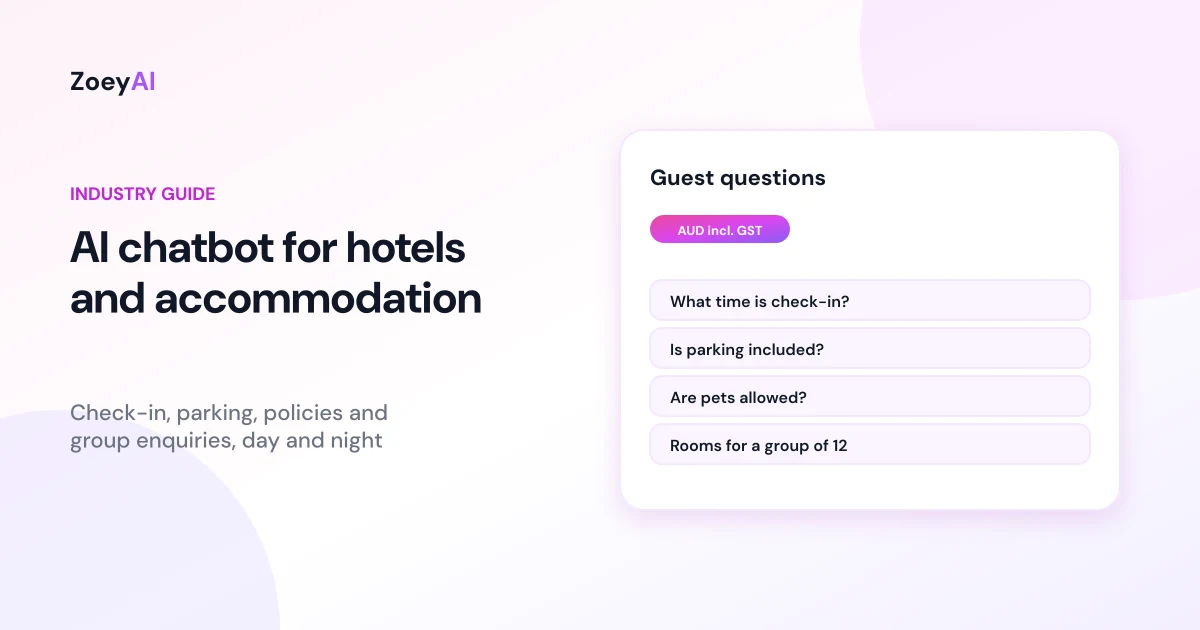
An AI chatbot for hotels and accommodation answers the questions guests ask before and after they book: what time is check-in, is there parking, are pets allowed, is breakfast included, can I check out late, do you have rooms for a group of twelve? Guests ask these questions at all hours, often while comparing your property with others on their phone. If the answer takes a day to arrive by email, many will book somewhere that answered first.
A chatbot can reply straight away using information your property has approved, send guests to your booking engine to check live availability and capture group, wedding and corporate enquiries for your team. This guide covers what an accommodation chatbot should do, what it should never promise, how to keep prices accurate and how to tell whether it is helping. It applies to hotels, motels, serviced apartments, B&Bs, holiday parks and short-stay operators.
What does an AI chatbot for hotels and accommodation actually do?
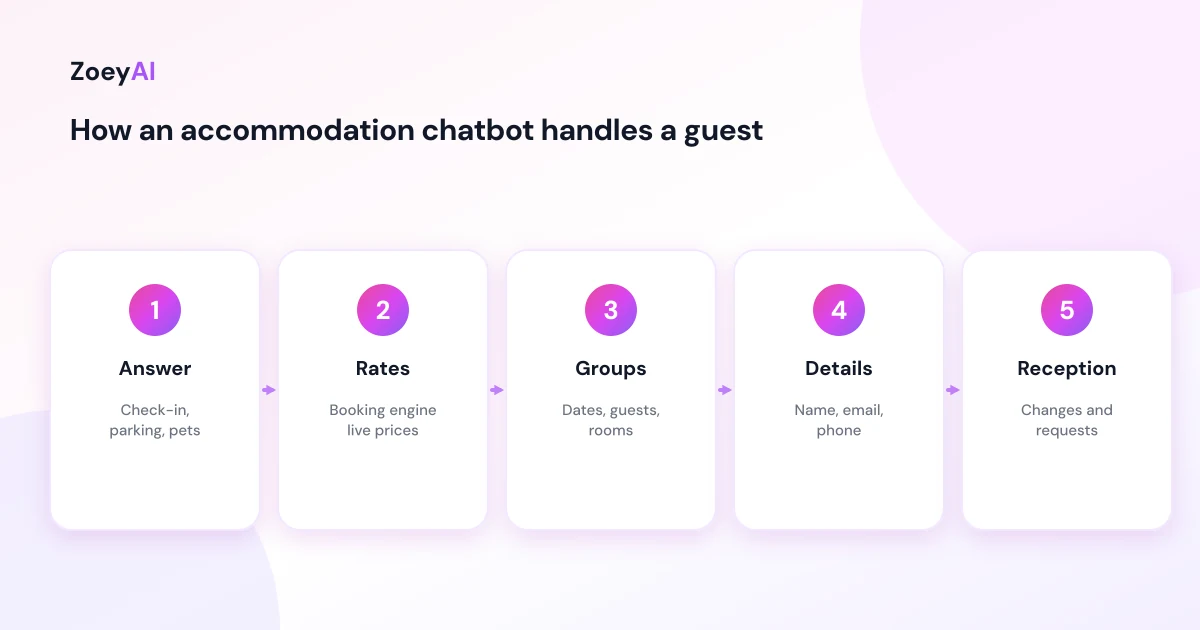
A well-set-up accommodation chatbot handles four kinds of enquiry:
- Pre-booking questions. Room types, what is included, check-in and check-out times, parking, pet policy, accessibility, Wi-Fi and distance to nearby attractions.
- Booking guidance. Linking the guest to your booking engine to see live rates and availability, and explaining your deposit and cancellation policies in your published words.
- Group and event enquiries. Weddings, conferences, sports teams and corporate stays. The chatbot captures dates, number of guests, rooms needed and contact details for your sales or reservations team.
- In-stay and pre-arrival questions. Late check-in instructions, luggage storage, restaurant hours, pool hours and how to contact reception.
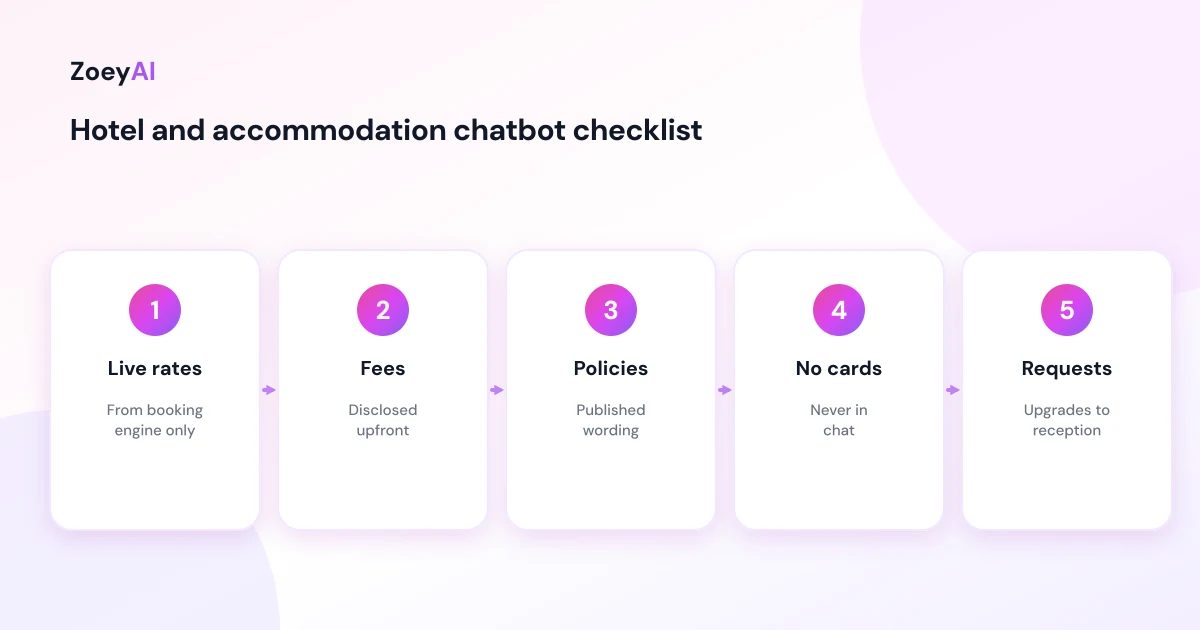
What it should not do is confirm availability or quote a rate it cannot see live, promise a room upgrade or late check-out, change or cancel a booking, or take card details in chat. Those belong to your booking engine and your front desk.
Keep prices and fees accurate
Accommodation pricing has more moving parts than most businesses: seasonal rates, minimum stays, cleaning fees, extra guest charges, resort fees and surcharges. The ACCC's guidance on price displays says businesses must communicate clear and accurate prices before consumers book, must display a total price that includes taxes and unavoidable fees, and must be upfront about the types of fees that will apply. It also describes "drip pricing", where extra fees are added during the booking process, as something businesses must avoid by disclosing fees at the start.
A chatbot reply is part of how you communicate prices, so set clear rules:
- Send guests to the booking engine for rates. Unless the chatbot can see live rates, it should not quote a nightly price. "You can see live rates and availability here" is safer than a guess.
- Disclose fees the way your website does. If you charge cleaning, pet or extra-guest fees, the chatbot should mention them using your published wording.
- No invented specials. If a package or promotion is not on your website, the chatbot should not mention it.
- GST-inclusive prices for consumers. If the chatbot repeats any published price, it should be the total price the guest will pay, as shown on your website.
Business Queensland's guide to advertising your business is a useful plain-English summary of the Australian Consumer Law rules on factual advertising and genuine discounts.
The questions an accommodation chatbot handles best
Typical questions a chatbot can answer from your own content:
- "What time is check-in and check-out?"
- "Is parking free, and is there a height limit?"
- "Are dogs allowed?"
- "Is breakfast included?"
- "Do you have accessible rooms?"
- "How far are you from the airport or the beach?"
- "What is your cancellation policy?"
- "Can I check in after midnight?"
- "Do you have a function room for 80 people?"
Group and event enquiries are often the most valuable conversations. Ask only what your team needs to reply: dates, number of guests, number of rooms, type of event and contact details. Our guide to AI chatbots for lead generation covers how to capture those details without turning the chat into a long form. If your property also has a restaurant or bar, our restaurant and cafe chatbot guide covers bookings, menus and allergen questions.
What to train an accommodation chatbot on
Keep the sources simple and current:
- Property details. Address, directions, parking, reception hours, check-in and check-out times and after-hours arrival instructions.
- Rooms and inclusions. Room types, bedding, maximum occupancy, inclusions such as breakfast or Wi-Fi, and accessibility features.
- Policies. Deposits, cancellations, pets, smoking, children, extra guests, damage and bond policies, in your published words.
- Facilities. Pool, gym, restaurant and laundry hours, and any facilities that close for maintenance or seasons.
- Local information. Distances and directions to common destinations, but avoid recommending third-party businesses you have not checked.
- A short "never do" list. No live rates unless connected, no availability guarantees, no upgrade or late check-out promises, no card details and no booking changes in chat.
Review seasonal details before each season. Pool hours, restaurant trading days and minimum stays change, and an out-of-date chatbot answer is worse than no answer.
Be open that guests are talking to AI
Guests should know when they are chatting with an AI assistant. The business.gov.au guide to artificial intelligence for business notes that customers want to know when they are talking to an AI rather than a human for customer support, and that your business is responsible for what your AI tools do. A greeting such as "Hi, I'm the property's AI assistant. I can answer questions about your stay or pass you to reception" sets the right expectation.
Guest details, privacy and marketing
Collect only what you need for the next step. For a group enquiry that is usually name, email, phone, dates and numbers. Never ask for card numbers, passport details or dates of birth in chat; those belong in your booking engine or at check-in. If your business is covered by the Privacy Act 1988, the Australian Privacy Principles apply to personal information collected through chat, and your privacy policy should explain how enquiries are used.
Replying to an enquiry is not the same as marketing. The Spam Act 2003 generally requires consent before you send commercial emails or texts, and each message needs a way to unsubscribe. If you want to add guests to a newsletter or special-offer list, ask separately and clearly.
Human handover: get guests to the right person
Route conversations by type:
- Booking changes, special requests and complaints to reception or reservations.
- Group, wedding and conference enquiries to your sales or events team, with all captured details attached.
- Late arrivals on the day to the after-hours phone number, not a next-day email.
- Urgent safety or security issues to the phone number on your website or emergency services, never the chat queue.
ZoeyAI lets a team member take over a live conversation from the dashboard on Basic and Pro plans, and business hours settings let the chatbot tell guests when reception will reply. Pro adds webhooks so captured group enquiries can be sent to tools like Zapier, Make or a CRM. If many of your guests ask questions late at night, our guide to AI chatbots for after-hours enquiries covers what to say when the desk is unattended.
How to tell if it is working
Look at practical results rather than chat counts:
- Group and event enquiries captured, and how many become bookings
- Clicks through to your booking engine from the chat, if you can track them
- Questions the chatbot could not answer, so you can add them to your content
- Repeat questions that suggest your website is missing information
- Accuracy, by reading a sample of conversations each week, especially after rate or policy changes
What it costs
ZoeyAI pricing is in AUD and includes GST. There is a free Starter plan for live chat without AI. AI plans start at $29 a month incl. GST on Basic (100 conversations a month, knowledge base, website scanner, business hours and human takeover) and $79 a month incl. GST on Pro (250 conversations a month, up to 5 team seats, webhooks, CSV export and branding removal). Enterprise pricing is available on request, and every new account starts with a 7-day free trial. See the pricing section for current details.
Frequently asked questions
Can an AI chatbot for hotels and accommodation take bookings?
It should link guests to your booking engine, where live rates and availability are shown. Unless it is connected to live data, it should not confirm availability or quote nightly rates.
Can the chatbot quote room prices?
Only prices you publish, shown as the total the guest will pay. The ACCC expects businesses to show total prices including unavoidable fees and to disclose other fees upfront, so the safest approach is to send guests to the booking engine for rates.
Should guests give card details in chat?
No. Card and identity details belong in your booking engine or at check-in, not in a chat conversation.
Can it handle wedding and group enquiries?
Yes. It can capture dates, guest numbers, rooms needed and contact details, then pass the enquiry to your sales or events team to follow up.
Does it work for motels, B&Bs and holiday parks?
Yes. Any accommodation business with a website and common guest questions can use a chatbot trained on its own information and policies.
Will a chatbot replace our reception team?
No. It answers routine questions and captures enquiries when reception is busy or unattended, so your team can focus on guests who need a person.
Keep reading
"AI Chatbot for Event Venues: Answer Capacity and Package Questions and Capture Enquiries"
How an AI chatbot for event venues answers questions about spaces, capacity, published packages and policies, captures wedding, corporate and party enquiries with the right details, treats dates as requests rather than bookings and hands every lead to your events team.
"AI Chatbot for Funeral Homes: Calm Answers and a Fast Path to Your Staff"
How an AI chatbot for funeral homes answers practical questions about services, published prices and what to do first, uses a calm and respectful tone, never pressures families, protects privacy and connects people with your staff quickly, including after hours.