
Industries
"AI Chatbot for Optometrists: Answer Patient Questions and Capture Appointment Requests"
By ZoeyAI · · 7 min read
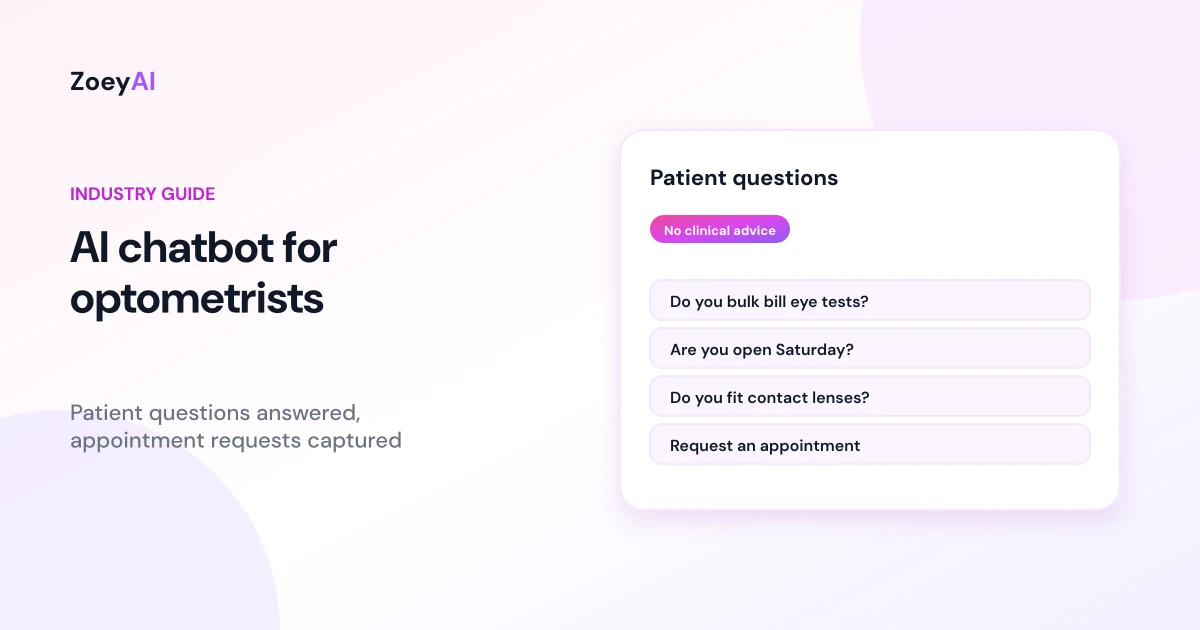
An AI chatbot for optometrists answers the questions patients ask before they book: do you bulk bill eye tests, are you open on Saturday, do I need a referral, do you fit contact lenses, and can I bring my own frames? Front desk staff in an optometry practice juggle phone calls, walk-ins, frame selections and collections, so website questions often wait until someone has a spare minute.
A chatbot can answer routine questions from your own website content, collect appointment requests and pass them to your team, while leaving anything clinical to your optometrists. This guide covers what an optometry chatbot should handle, where it must stop and how to set it up so it supports your front desk without giving health advice.
What does an AI chatbot for optometrists do?
Whether you run an independent practice, a multi-location group or a practice with a large optical dispensary, the chatbot works like a receptionist who answers the website at any hour. It:
- Explains your services. Comprehensive eye tests, children's vision, contact lens fittings, dry eye services, driver's licence vision checks and anything else you list.
- Answers practical questions. Opening hours, locations, parking, accessibility and what to bring to an appointment.
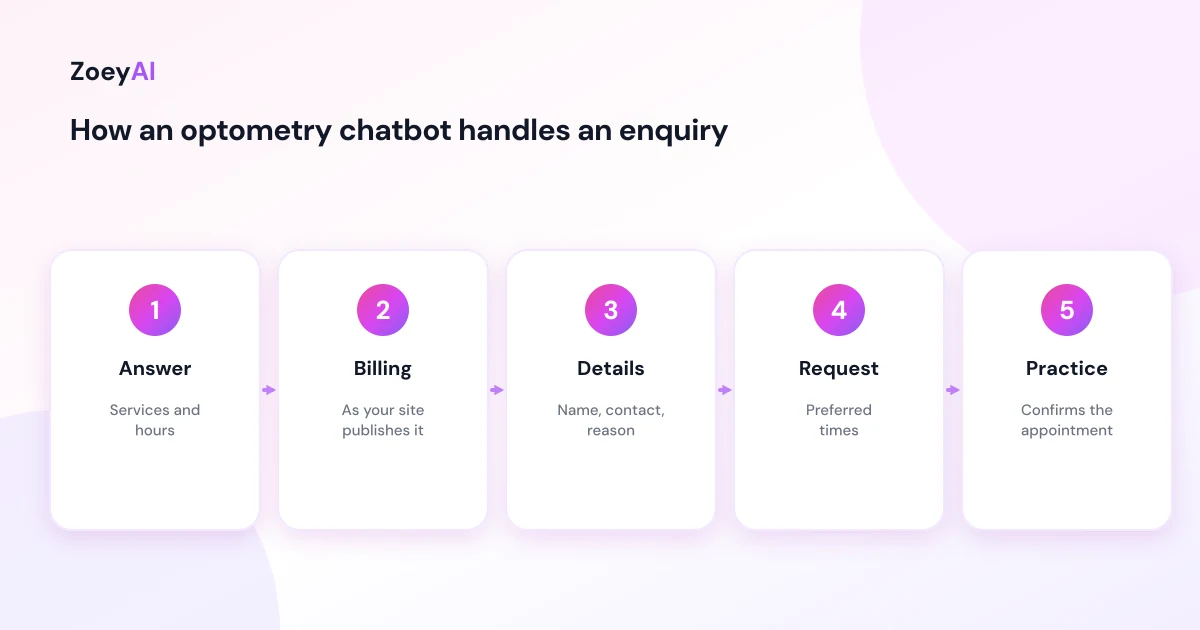
- Describes billing as published. Whether you bulk bill eligible eye tests, what gaps may apply and which health funds you work with, in your own words.
- Covers frames and lenses. Brands you stock, lens options, collection times and repair policies, as published on your website.
- Captures appointment requests. Name, phone, email, the type of appointment and preferred times, then sends them to your team or points to your online booking page.
What the chatbot should not do
Optometry is a regulated health profession, and the line between an administrative answer and clinical advice matters. The chatbot should not:
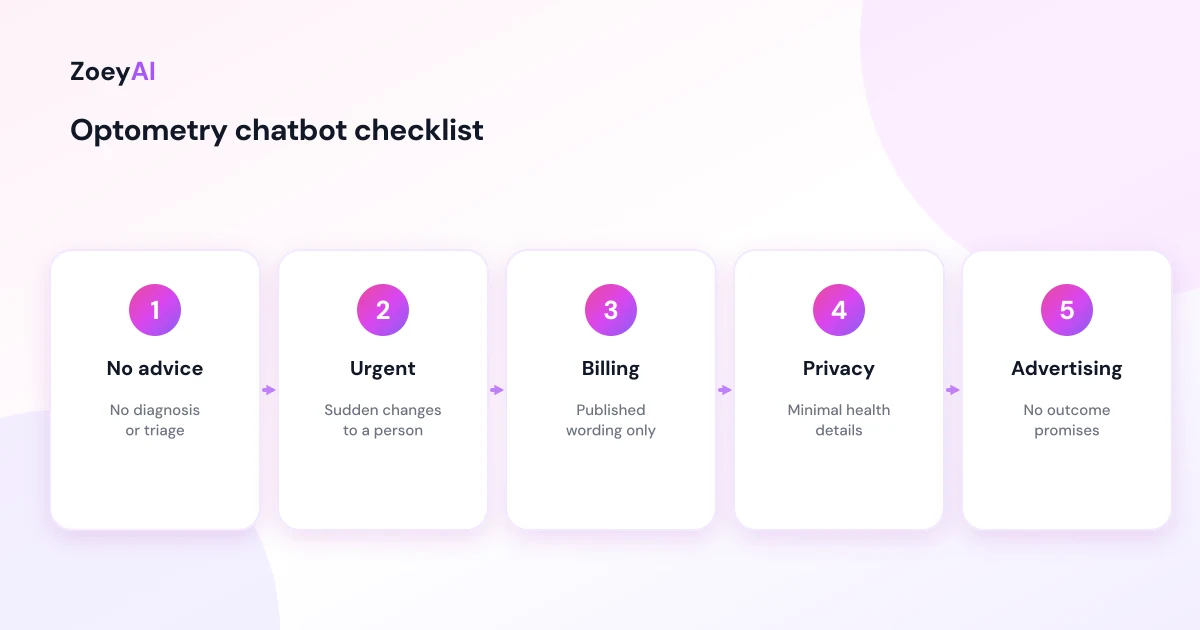
- Diagnose, triage or comment on symptoms.
- Recommend a type of lens, treatment or eye drop for a particular person.
- Say whether someone needs an eye test sooner rather than later because of their symptoms.
- Interpret a prescription or test result.
Instead, it should give a clear, consistent response: "I can't give advice about symptoms or eye health. Our optometrists can help at your appointment, and I can take your details so the practice can contact you."
Urgent symptoms go to a person
Some eye problems need prompt care. Sudden changes in vision, eye injuries, chemicals in the eye or severe pain should never sit in a chatbot queue. Set up the chatbot so that when someone describes symptoms like these, it tells them to call the practice during opening hours, and to seek urgent medical care or call triple zero (000) in an emergency. Ask your optometrists to approve the exact wording the chatbot uses for these situations, and test it with a few example messages before you go live.
Our guide to AI chatbot human handover best practices covers how to word escalations so patients know exactly what to do next.
Bulk billing and fees
Billing is one of the most common questions, and also one of the easiest to get wrong. Healthdirect's page on eye tests explains that you don't need a doctor's referral to see an optometrist for an eye test and that the cost of an eye test is usually covered by Medicare. Services Australia's page on bulk billing notes that bulk billing can cover eye tests performed by optometrists, that not all health professionals bulk bill and that patients should check when they make an appointment.
That last point is why the chatbot should repeat your practice's own published billing policy rather than a general rule. If you bulk bill eligible eye tests, say so in your own words on your website, along with any situations where a fee applies, for example additional tests or a contact lens fitting. If your policy varies, the chatbot can say the practice will confirm any costs when the appointment is booked.
Appointment requests
If you use an online booking system, the chatbot can point patients to it. If you prefer to book by phone or need to check details first, the chatbot can collect a request:
- Name and contact details.
- Appointment type. Eye test, contact lens fitting, children's vision, follow-up or frame adjustment.
- Preferred days and times. Recorded as preferences, not confirmed slots.
- Medicare card. Only whether they have one, if your team asks this before booking. Keep card numbers out of the chat.
- Anything else the team should know, without asking for detailed health history.
The chatbot should tell the patient what happens next, for example "Our team will call you to confirm a time" if that is how you work.
Privacy and health information
Patients sometimes share health details in a chat without being asked. Health information is sensitive information under Australian privacy law, and it needs extra care. The OAIC's page on health information and your privacy explains what counts as health information and how it should be handled.
Keep the chatbot's questions to what your front desk needs to book, avoid asking for symptoms or medical history and make sure your privacy policy covers website chat. Our guide to AI chatbot privacy in Australia covers the broader setup.
Advertising rules apply to chatbot answers
What your website says about your services counts as advertising of a regulated health service, and a chatbot reply is part of that. Ahpra's advertising hub explains that health advertising must not be false or misleading and links to the advertising guidelines, including the rules on testimonials. The Optometry Board of Australia publishes the codes and guidelines that apply to the profession.
In practice, that means the chatbot should not promise outcomes, compare your practice with others in a way you cannot support or repeat patient reviews about clinical care. Keep its answers factual and based on the content your team has approved.
Questions an optometry chatbot handles well
These appear on most practice websites and can be answered from your own content:
- "Do you bulk bill eye tests?"
- "Do I need a referral?"
- "Are you open on Saturdays?"
- "Do you see children?"
- "Do you fit contact lenses?"
- "Which health funds do you work with?"
- "How long does it take for glasses to be ready?"
- "Can you adjust frames I bought elsewhere?"
Questions to pass to your team include anything about symptoms, results, prescriptions, specific lens recommendations, complaints and urgent problems.
Handing requests to your team
ZoeyAI captures enquiries as leads and notifies your team, with any custom fields you set up, such as appointment type. On Basic and Pro plans a team member can take over the conversation live from the dashboard, and business hours settings let the chatbot tell patients when the practice will reply. Multi-location practices on Pro can give up to 5 team members access to the dashboard.
How to tell if it is working
Use your own records rather than general benchmarks:
- Appointment requests captured, especially outside opening hours
- Calls avoided for routine questions about hours, billing and referrals
- Questions the chatbot could not answer, so you can add them to your website
- Conversations escalated for symptoms, and how quickly your team followed up
What it costs
ZoeyAI pricing is in AUD and includes GST. There is a free Starter plan for live chat without AI. AI plans start at $29 a month incl. GST on Basic (100 conversations a month, knowledge base, website scanner, business hours and human takeover) and $79 a month incl. GST on Pro (250 conversations a month, up to 5 team seats, webhooks, CSV export and branding removal). Enterprise pricing is available on request, and every new account starts with a 7-day free trial. See the pricing section for current details.
Frequently asked questions
What can an AI chatbot for optometrists answer?
Administrative questions your website already answers: services, opening hours, locations, billing as published, health funds, frames and lens options, collection times and how to book.
Can the chatbot give advice about eye symptoms?
No. It should not diagnose or triage. It directs patients to call the practice and, for sudden vision changes, injuries or severe pain, to seek urgent care or call 000 in an emergency.
Can the chatbot say whether an eye test is bulk billed?
It can repeat your practice's published billing policy. If costs vary, it says the practice will confirm when the appointment is booked.
Can it book appointments?
It can point patients to your online booking page or collect a request with preferred times for your team to confirm.
What about patient privacy?
Keep questions to booking details, avoid collecting health history in chat and make sure your privacy policy covers the chatbot.
Does Ahpra's advertising guidance apply to chatbot replies?
The chatbot is part of how your practice presents its services, so keep its answers factual, avoid testimonials about clinical care and check them against Ahpra's advertising guidance.
Keep reading
"AI Chatbot for Event Venues: Answer Capacity and Package Questions and Capture Enquiries"
How an AI chatbot for event venues answers questions about spaces, capacity, published packages and policies, captures wedding, corporate and party enquiries with the right details, treats dates as requests rather than bookings and hands every lead to your events team.
"AI Chatbot for Funeral Homes: Calm Answers and a Fast Path to Your Staff"
How an AI chatbot for funeral homes answers practical questions about services, published prices and what to do first, uses a calm and respectful tone, never pressures families, protects privacy and connects people with your staff quickly, including after hours.