
Industries
"AI Chatbot for Veterinary Clinics: Answer Pet Owners and Capture Bookings"
By ZoeyAI · · 7 min read
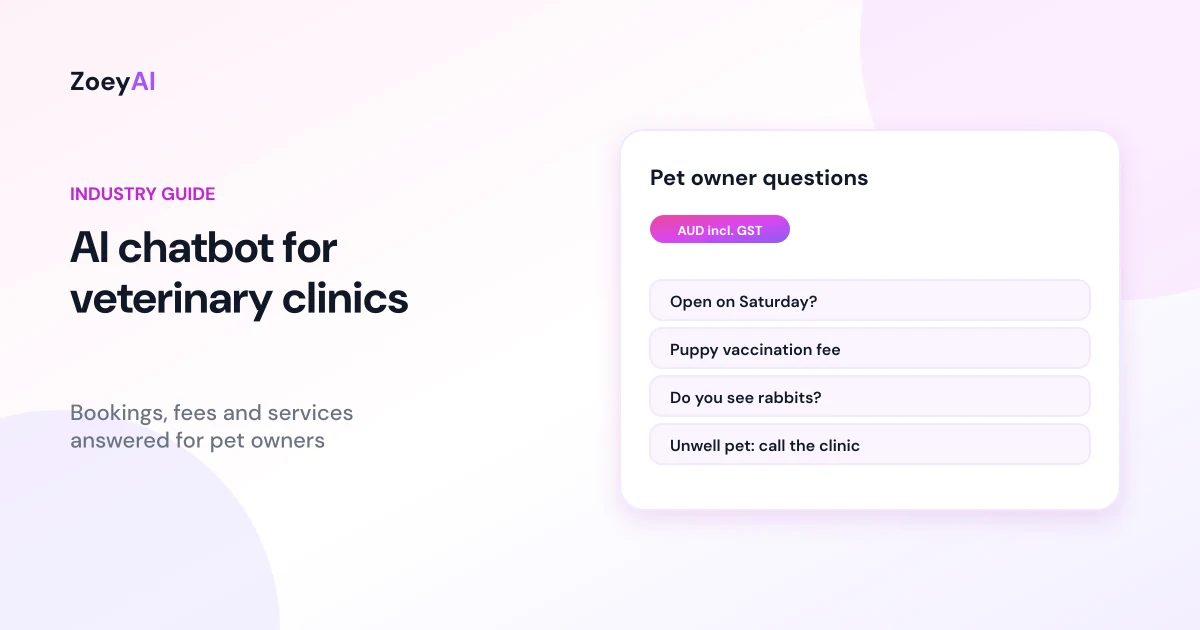
An AI chatbot for veterinary clinics answers the everyday questions pet owners ask on your website: are you open on Saturday, how much is a vaccination, do you see rabbits and birds, can I book a desexing, where do I park? Your reception team hears these questions all day, usually while the phone is ringing and a nervous dog is waiting at the counter. Many more arrive at night, when an owner is browsing for a new vet or planning next week's check-up.
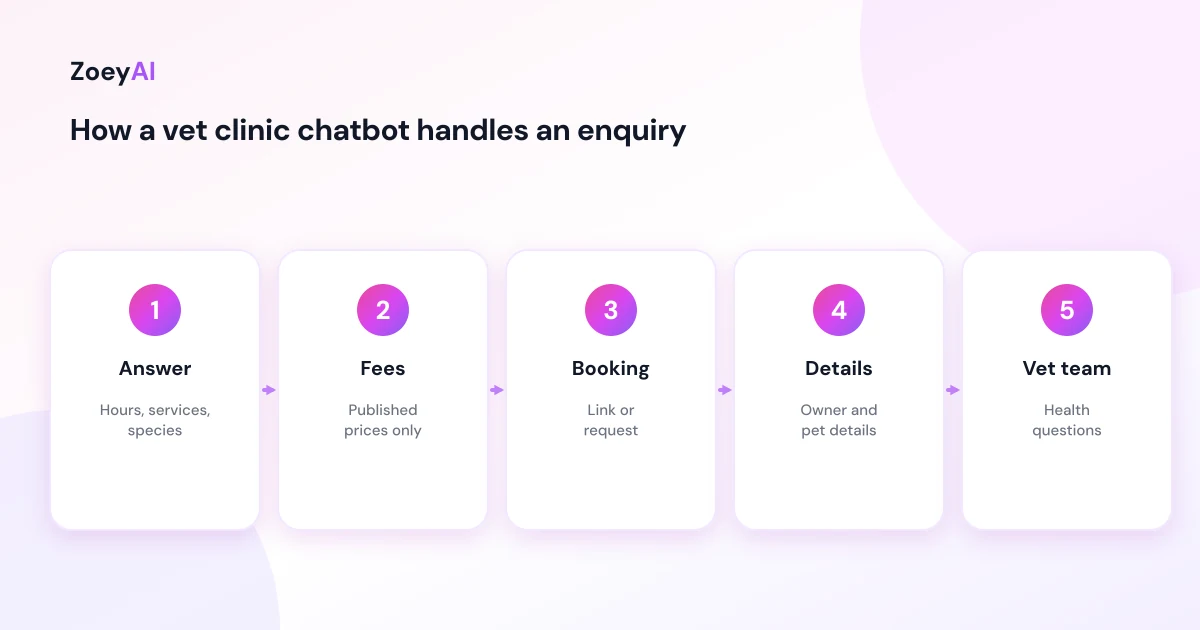
A chatbot can answer straight away from information your clinic has approved, capture a booking request and pass anything about an animal's health to your team. This guide covers what a vet clinic chatbot should handle, where it must stop, how to deal with emergencies, and how to check it is helping rather than adding work.
What does an AI chatbot for veterinary clinics actually do?
A well-set-up vet chatbot sticks to four kinds of enquiry:
- Appointments. Which days you consult, how to book online, how long a standard consult takes and what to bring for a first visit. If you use an online booking system, the chatbot links to it. If not, it collects a booking request for reception to confirm.
- Fees and payment. Published prices for consultations, vaccinations, desexing or dental checks, payment options and whether you accept pet insurance claims at the counter.
- Services and species. The services listed on your website, the animals you see, and whether you offer things like puppy preschool, grooming or boarding.
- Practical details. Locations, opening hours, public holiday closures, parking and drop-off times for surgery.
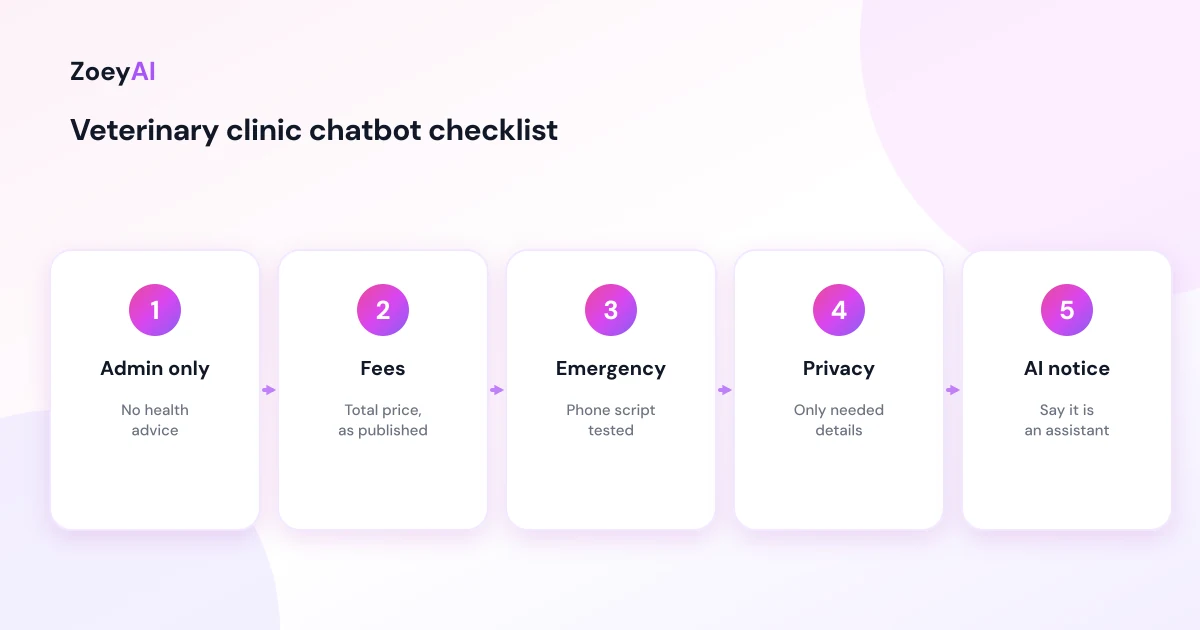
What it should not do is assess symptoms, suggest medications or doses, say whether something "sounds serious", or recommend a treatment. Those calls belong to a registered veterinarian who can examine the animal.
Keep it administrative: no animal health advice
The core rule is that a vet clinic chatbot is a receptionist, not a vet. Owners often describe symptoms in chat ("my cat hasn't eaten since yesterday, should I worry?"). The chatbot should not interpret them. A good reply acknowledges the concern, explains that a vet needs to assess the animal, and offers the fastest next step: book a consult, call the clinic, or, if it may be urgent, call straight away.
Veterinary practice is regulated by state and territory boards. In Victoria, for example, the Veterinary Practitioners Registration Board publishes guidelines on appropriate standards of veterinary practice, and its recent newsletters have covered remote advice and delegating tasks to non-veterinary staff. A website chatbot that never gives clinical advice avoids blurring the line between reception and a consultation. Check the guidelines that apply in your own state.
Emergencies go to the phone, never the chat queue
Emergencies are where a vet chatbot needs the clearest script. If an owner mentions breathing difficulty, collapse, suspected poisoning, a snake bite, heavy bleeding, a dog that cannot pass urine, or anything else your team treats as urgent, the chatbot should:
- Tell the owner to call the clinic now on your phone number.
- Give your after-hours or emergency hospital details if the clinic is closed.
- Not ask follow-up questions about symptoms or try to triage.
Write this response with your vets, add your real numbers and test it with a dozen different phrasings. Do it before launch, and again whenever your after-hours arrangements change. Our guide to AI chatbots for after-hours enquiries covers how to set expectations when nobody is in the clinic.
Prices must be accurate and complete
Owners ask about cost constantly, and the chatbot should only quote what you publish. The ACCC's guidance on price displays says businesses must show clear, accurate prices before consumers book or buy, and must display a total price that includes taxes and all unavoidable fees. If your consult fee changes on weekends or public holidays, or a vaccination price depends on the animal's size, the chatbot should say so plainly.
Practical rules for fee answers:
- Published prices only. Train the chatbot on your fee page, not on old flyers or staff memory.
- Say what is included. For example, whether a vaccination price includes the consultation.
- Flag variable costs. Surgery, dental and diagnostic costs usually depend on the examination. The chatbot should say a vet will provide an estimate rather than guess.
- Insurance questions to reception. The chatbot can say whether you process claims at the counter, but cover and claim outcomes are between the owner and their insurer.
Questions a vet chatbot handles well
Typical questions a chatbot can answer from your own content:
- "Do you have appointments on Saturday?"
- "How much is a puppy vaccination?"
- "Do you see rabbits, guinea pigs or birds?"
- "What time do I drop my dog off for surgery?"
- "Can I book a nail trim without a consultation?"
- "Do you offer payment plans?"
- "Where is the nearest after-hours vet?"
- "Is there parking out the front?"
If an answer is not on your website yet, write it as a short FAQ in your clinic's own words before adding it to the chatbot.
What to train a vet clinic chatbot on
Keep the knowledge base short and current:
- Clinic details. Locations, hours, public holiday closures, parking, phone numbers and your after-hours arrangements.
- Services and species. What you offer, in the same words your website uses, and which animals you see.
- Fees and policies. Published fees, payment options, cancellation and deposit policies, and pre-surgery instructions you already give owners in writing.
- Booking. Your online booking link, or the details reception needs for a booking request: owner name, phone, pet name, species, reason for visit and preferred times.
- A "never do" list. No symptom assessment, no medication or dosage advice, no diagnosis, no prices you have not published and no promises about outcomes.
Our guide on how to train an AI chatbot on your website content walks through scanning your site and filling the gaps.
Owner details and privacy
A vet chatbot collects personal information about owners: names, phone numbers, emails and sometimes addresses. The Privacy Act 1988 and the Australian Privacy Principles may apply to your clinic, depending on its size and circumstances, and many clinics follow them as good practice regardless. Collect only what you need to book or call back, explain in your privacy policy how chat enquiries are handled, and do not ask for payment card details in chat.
Make sure the greeting says it is an AI assistant. A simple opener works: "Hi, I'm the clinic's AI assistant. I can help with bookings, fees and general questions. If your pet is unwell or injured, please call us on [number] straight away."
Human handover: get owners to the right person
Route conversations by type:
- Booking requests to reception, with pet details and preferred times.
- Health questions to a vet or nurse, usually by booking a consult or a call-back.
- Estimates and accounts to the practice manager or reception.
- Complaints to the practice manager.
- Emergencies to the phone, every time.
ZoeyAI lets a team member take over a live conversation from the dashboard on Basic and Pro plans, and business hours settings let the chatbot tell owners when the clinic will reply. Our human handover best practices explain how to make the switch smooth.
How to tell if it is working
Track practical results rather than chat volume:
- Booking requests captured, especially outside opening hours
- How quickly reception confirms them
- Questions the chatbot could not answer, so you can add them to the knowledge base
- Conversations about symptoms, to check every one was handed over or sent to the phone
- Accuracy, by reading a sample of conversations each week
What it costs
ZoeyAI pricing is in AUD and includes GST. There is a free Starter plan for live chat without AI. AI plans start at $29 a month incl. GST on Basic (100 conversations a month, knowledge base, website scanner, business hours and human takeover) and $79 a month incl. GST on Pro (250 conversations a month, up to 5 team seats, webhooks, CSV export and branding removal). Enterprise pricing is available on request, and every new account starts with a 7-day free trial. See the pricing section for current details.
Frequently asked questions
Can an AI chatbot for veterinary clinics give advice about a sick pet?
No. It should stick to administrative questions such as bookings, fees, services and locations. Anything about symptoms, medications or treatment should go to a vet, and anything that might be urgent should go to the phone.
What should the chatbot do in an emergency?
Tell the owner to call the clinic straight away, or give your after-hours emergency details if you are closed. It should not ask about symptoms or try to triage.
Can the chatbot book appointments?
It can link owners to your online booking system or capture a booking request with owner and pet details and preferred times for reception to confirm.
Can it quote prices for surgery?
Only the prices you publish. Surgical and dental costs usually depend on an examination, so the chatbot should explain that a vet will provide an estimate.
Should the chatbot say it is an AI?
Yes. A clear greeting avoids confusion and sets the expectation that health questions go to your team.
Will a chatbot replace our reception team?
No. It handles routine questions and captures booking requests when reception is busy or the clinic is closed, so your team can focus on the animals and owners in front of them.
Keep reading
"AI Chatbot for Event Venues: Answer Capacity and Package Questions and Capture Enquiries"
How an AI chatbot for event venues answers questions about spaces, capacity, published packages and policies, captures wedding, corporate and party enquiries with the right details, treats dates as requests rather than bookings and hands every lead to your events team.
"AI Chatbot for Funeral Homes: Calm Answers and a Fast Path to Your Staff"
How an AI chatbot for funeral homes answers practical questions about services, published prices and what to do first, uses a calm and respectful tone, never pressures families, protects privacy and connects people with your staff quickly, including after hours.